Non-Invasive Prenatal Tests (NIPT).

This blood test, available after 10 weeks of pregnancy, is the most effective screening test currently available for Trisomy 21 (Down syndrome) and other chromosomal abnormalities.
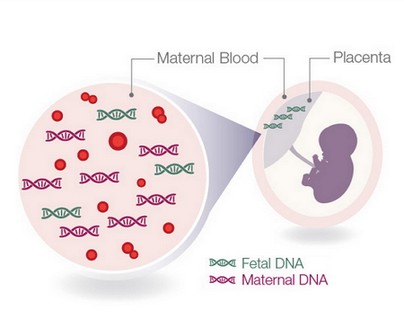
It is not 100% accurate, but comes very close, particularly for Trisomy 21. It does not work for every pregnancy, with no result available in 1-4% of pregnancies. Positive results from NIPT should ideally be confirmed with amniocentesis, or CVS. The NIPT is based on the presence of DNA from the pregnancy (mainly the placenta) found in the mother’s blood. All NIPT’s test for Trisomies 21 (Down syndrome), 18 (Edward syndrome) and 13 (Patau syndrome) as standard. You can choose to test for Monosomy X (Turner syndrome – a girl with only one X chromosome) or other abnormalities of the sex chromosomes, including Klinefelter syndrome (a boy with an additional X chromosome).
You can also choose to find out the sex of your unborn baby, either as part of checking for the abnormalities above, or just as an addition to the standard Trisomy tests. Some NIPT’s offer additional testing for other syndromes, caused by abnormal genetic information within a chromosome. In rare circumstances, it can be beneficial to a couple to use NIPT to check for genetic problems specific to their family or situation. In these situations, taking advice from your doctor or a genetics counsellor is important.
When considering a screening test for pregnancy, it is important that you understand what conditions are being tested for, what a positive result might mean and how you will use the information to guide your pregnancy care. Some people like to know as much about their unborn baby as possible. Others feel that knowing information that doesn’t change their intended care may only cause additional anxiety, and choose not to test. NIPT has been available for over 10 years now, and your GP or Obstetrician will likely be very happy to discuss it with you, and provide you with a referral if desired. However, if needed, we can also assist with these referrals.
More information about NIPT can be found via some of the sites links in our Resources page.
Non-Invasive Prenatal Tests (NIPT) are blood tests offered after 10 weeks of pregnancy. They give a near-diagnostic level of accuracy for the commonest chromosome problems in pregnancy – trisomies 21, 18 and 13, as well as the option to check for sex chromosome anomalies.
Results are based on ratios of the “fetal” fraction of cell-free DNA in the mother’s blood.
NIPT can be performed from 10 weeks of pregnancy. Many parents choose it in place of the standard combined First Trimester Screening (ultrasound + different blood test) due to its very high accuracy. Blood should not be taken for NIPT before 10 weeks as there is a greater chance of not getting a result.
Sometimes, even after 10 weeks, the lab cannot give a result for a NIPT. When this happens, the test is usually repeated by the lab, on a new blood sample, at no additional cost. If the second blood test still doesn’t give a result, a specialised ultrasound and opinion may be recommended by your doctor.
If a definite problem has already been identified in a pregnancy, NIPT may not be the ideal choice. This is because it is not a definitive test and it does not cover the full range of chromosome problems (20% of significant chromosome abnormalities are caused by conditions which are not checked). We, or the referring doctor, can provide guidance, sometimes in conjunction with the 12 or 13 week ultrasound for structural abnormalities.

It is important to understand that if a very high chance of a chromosome problem such as Down Syndrome is detected on NIPT, a definitive test (Amnio or CVS) is then offered, since there are occasional false positive results in the blood test.
NIPT is mainly to check for trisomies (a single extra copy of one of the pairs of chromosomes). You will need to decide whether to also have the sex chromosomes checked for anomalies. This is a separate decision from whether you want to know the baby’s sex.
The sex chromosome abnormalities include a variety of conditions ranging from very mild to severe problems. Some can be better managed in childhood if the chromosome anomaly is identified from birth, rather than first diagnosed later in life when symptoms might start to show.
Microdeletion screens (for health problems caused by very small changes within a chromosome) are offered at extra cost by some labs and can have more problems with accuracy, both false positives and negatives.
The test only covers the 80% of babies affected by the most common chromosome defects. This includes trisomy 21, trisomy 18, trisomy 13 and potentially, abnormalities of the sex chromosomes. It is not designed to pick up mosaicism (where only some cells are affected) or most partial chromosome deletions. Although NIPT is called a “fetal” test, it is really the placental DNA that is mainly analysed. This is not usually a problem with the common trisomies but requires careful consideration if a sex chromosome anomaly is found. Occasionally the chromosomes in the baby can be different from the chromosomes in the placenta.
Many fetal health problems are not covered by NIPT, so the usual 12/13 week and 19-21 week ultrasounds are still recommended for structural information.
The main differences in choice of lab are
At QDOS Ultrasound, we have not aligned with a single lab, so the choice of lab can be tailored for each clinical situation.
Twins – NIPT can be used, and is still a good option even though it does not work quite as well in non-identical twins as in single pregnancy.
These tests are very rapidly developing, please discuss any specific queries with your Doctor or at the ultrasound. For more information, download the pdf below.
Receive professional, compassionate care from our experienced team. Book an ultrasound appointment at a time that works best for you and take the next step in your pregnancy journey.

QDOS Ultrasound provides specialist obstetric and gynaecology ultrasound performed by highly experienced and motivated doctors and sonographers. The rooms are purpose-built, located on the ground floor at 12 Connolly Street, West Leederville, at the rear of Connolly House, which is on the corner of Connolly and Cambridge Streets, opposite SJOG Hospital Subiaco.
Pregnancy
Gynaecology
Contact
Address
12 Connolly St, West Leederville
PERTH – Western Australia 6007
Monday – Friday
8:00 am – 4:45 pm
(strictly by appointment only)
© 2025 QDOS Ultrasound. All rights reserved. | Designed and Created by MMS